
Workload Emissivity Effect on Heating in a Vacuum Furnace
The heating of a workload in a vacuum furnace is accomplished via energy radiating from the furnace elements to the load materials. There are several complex factors that affect the overall time it takes for the materials to reach uniform process temperature including load weight, part cross-section, heating rate, etc. Another important factor relates to the “emissivity” directly affecting the “heat absorption capability” of the material being processed.
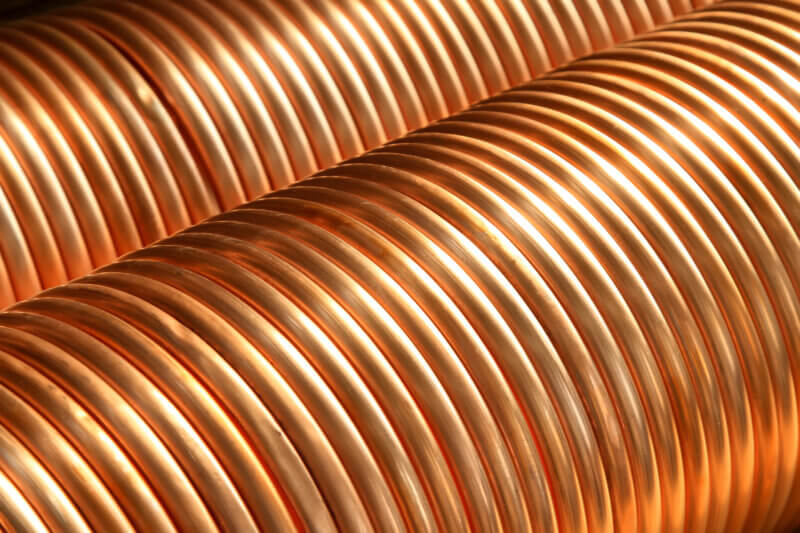
In radiation, all materials have an emissivity co-efficient – Є – which indicates the radiation of heat from this “gray body” according to the Stefan-Boltzmann Law compared to the radiation of heat from an ideal “black body” with the emissivity co-efficient of Є = 1. Emissivity can be thought of as an effect of color and surface texture. Bright, shiny materials could have an emissivity co-efficient Є =.03 while darker or oxidized material could have an emissivity co-efficient Є =.95.
Emissivity of materials is also directly related to the ability of the material to absorb the radiating heat. Black body materials will absorb heat faster than gray or bright colored materials. This explains why on hot sunny days blacktop roads are warmer than the lighter colored concrete sidewalks.
The object of our experiment was to demonstrate the effect of the material emissivity on the radiant heating rate of two different parts of the same material and size that had been purposely changed to affect the surface emissivity of the material. One block was copper plated to AMS 2418 and compared to the second test block that was not copper plated and had a gray metallic finish. Both were identical in mass, cross section, material and relative location in the furnace. The only difference was the colored appearances (Figure 1). Thermocouples were inserted within a hole drilled into the center of each block.