
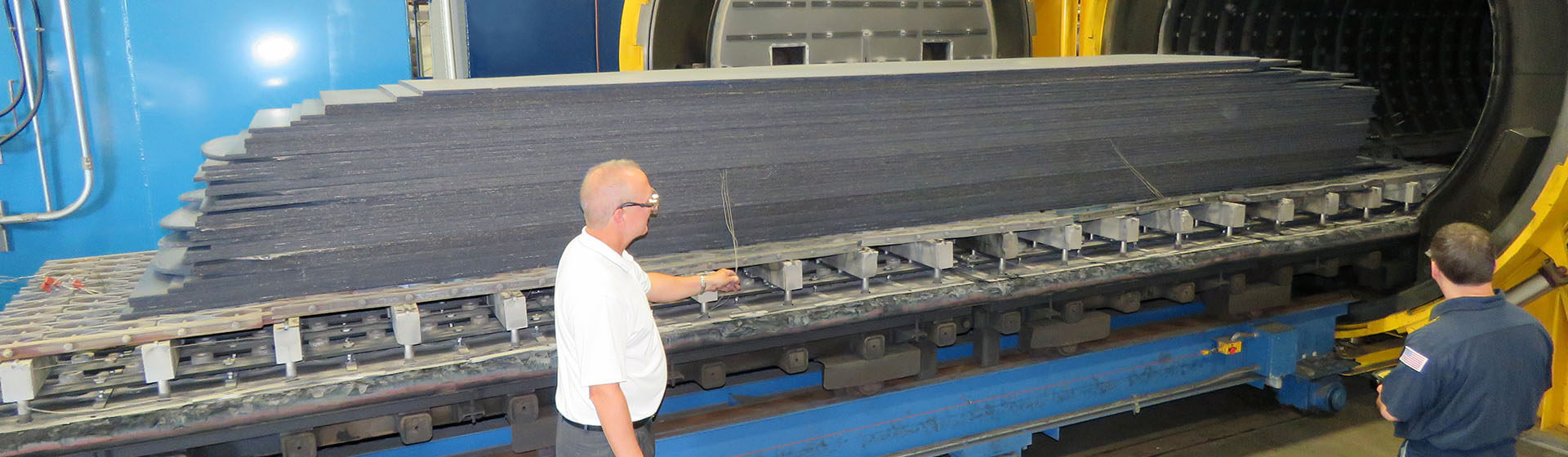
Vacuum Degassing Services
Improve the quality, strength and reliability of metals
Vacuum Degassing Services
Remove Detrimental Elements
Vacuum degassing services can improve the quality, strength and reliability of metals by removing detrimental elements such as hydrogen, nitrogen and oxygen, which may be harmful to the integrity of the metal. Hydrogen is one of the more common interstitial impurities which requires degassing. Vacuum degassing can be used for very small impurity levels (<100 ppm) to very high hydrogen levels. Post degas treatments typically result in <10 ppm of contaminant. In addition to hydrogen impurities, nitrogen, moisture, sulfur and oxide impurities can also be removed through specific degassing processes too.
Unique Capabilities
- Complete line of vacuum furnaces ranging from small R&D lab sized to large 48 foot long
- Precise temperature controls
- Various inert or reducing gases available
- Access to a R&D technology team of scientists and metallurgists to help with setup design and process cycle development
Components Processed
- Sheet Metal
- Plate
- Billets
- Bar
- Rod
- Wire
- Coils
- Finished Machined Parts
- Powder
- And more!
Materials Processed
- Titanium
- Tantalum
- Niobium
- Stainless Steels
- Tool Steels
Frequently Asked Questions
Titanium degassing, also known as hydrogen bakeout, is a vacuum heat treatment process used to remove dissolved hydrogen from titanium raw materials, forgings, sheet, components, scrap, and powder.
Hydrogen can be absorbed during manufacturing processes such as melting, welding, chemical processing, or superplastic forming. Excess hydrogen reduces the ductility and toughness of titanium and can lead to hydrogen embrittlement, increasing the risk of premature component failure.
During degassing, titanium is heated in a high-vacuum furnace—typically above 1,250°F (677°C)—allowing hydrogen to diffuse out of the material while preventing surface contamination. Depending on the required final hydrogen content, vacuum levels may range from 10⁻³ Torr (1 micron) to 10⁻⁵ or 10⁻⁶ Torr for the most demanding aerospace applications.
Yes. Hydrogen degassing is commonly performed on Superplastic Formed (SPF) titanium components.
During the SPF process, titanium is typically formed at approximately 1,650°F (899°C) using gas pressure. If forming is performed outside of a high-quality vacuum or controlled atmosphere, the material can absorb hydrogen, increasing its hydrogen content and potentially reducing mechanical performance.
The good news is that hydrogen absorption is reversible. By reheating the component above 1,250°F (677°C) in a high-vacuum furnace, the absorbed hydrogen diffuses out of the titanium. For flight-critical aerospace components requiring extremely low hydrogen levels, vacuum levels of 10⁻⁵ Torr or better are typically recommended.
Yes. In many cases, annealing and hydrogen degassing can be performed during the same vacuum heat treatment cycle.
Combining both processes reduces processing time while restoring the desired microstructure and reducing hydrogen content. To achieve the best results, the furnace should be equipped with high-vacuum pumping systems capable of maintaining vacuum levels of 10⁻⁴ to 10⁻⁵ Torr or better throughout the cycle.
Hydrogen removal begins as the titanium approaches approximately 900°F (482°C) and continues as temperature increases.
Hydrogen removal can often be observed during the vacuum heat treatment cycle.
As the titanium is heated above approximately 900°F (482°C), hydrogen begins to diffuse from the material into the furnace atmosphere. This typically causes a temporary rise in furnace pressure before the vacuum level recovers as the pumping system removes the released hydrogen.
A typical degassing cycle includes:
- Heating the titanium to the required degassing temperature (commonly around 1,350°F (732°C)).
- Allowing the vacuum level to recover after hydrogen evolution decreases.
- Holding the material at temperature for approximately two additional hours to maximize hydrogen removal.
For critical applications, hydrogen content should be verified with laboratory analysis before and after processing to confirm compliance with the required specification.
Hydrogen degassing helps restore the mechanical integrity of titanium by reducing hydrogen to acceptable levels. Benefits include:
- Reduced risk of hydrogen embrittlement
- Improved ductility and toughness
- Enhanced fatigue performance
- Compliance with aerospace and other critical material specifications
- Improved reliability for high-performance components
For aerospace, medical, and other demanding applications, vacuum hydrogen degassing is an essential step in ensuring long-term material performance.