
Low Pressure Carburizing (LPC)
Low Pressure Carburizing (LPC)
Uniform, High Quality Case
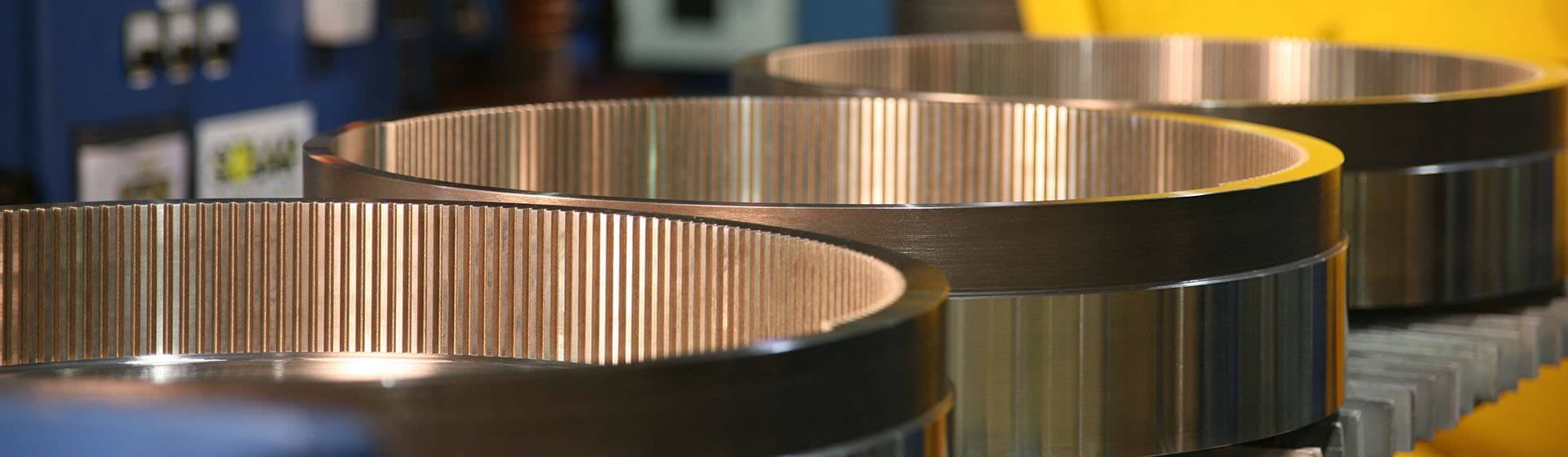
Low Pressure Carburizing (LPC) is a specialized, highly technical process pioneered by Solar Atmospheres designed to increase fatigue life and improve wear properties of your parts. The case hardened surface is supported by a ductile, shock-absorbing core capable of withstanding high load bearing applications. LPC produces a uniform, high-quality case with minimized distortion and absence of Intergranular Oxidation (IGO), reducing or eliminating expensive post heat treating machining operations.
Unique Capabilities
- Conformance to SAE specification ASM 2759/7
- Cycle automation for process repeatability
- Customized cycle development
- Efficient single vacuum chamber technology
- Minimized distortion through gas quenching up to 20 bar
- Shorter cycle times for fast turn-around
- Case hardening – uniform case depth including holes and keyways
- On-site Metallurgical Test Lab, Nadcap Accredited
- State-of-the-art furnaces from Solar Manufacturing
- 90%+ root to pitch case depth ratios for gearing applications
Materials Processed
- 8620
- 9310
- 3310
- 41 & 4320 / 30 / 40
- Vasco X2
- Pyrowear 53 & 675
- Ferrium C61 & C64
- CSS-42L
- M50 NiL
Solar specializes in low pressure carburizing to achieve optimum case hardening in various alloy materials such as mold, tool, specialized, high strength or martensitic stainless steels. Watch our short video to find out more!
Frequently Asked Questions
Low pressure carburizing (LPC), also known as vacuum carburizing, is performed in a vacuum furnace using high-purity acetylene (C₂H₂) as the carbon source and high-pressure inert gas (typically 10–20 bar) for quenching. Traditional carburizing uses an endothermic gas atmosphere followed by an oil quench. The vacuum process provides a cleaner environment, improved process control, and reduced distortion.
Vacuum carburizing offers several advantages over conventional carburizing, including:
- Reduced part distortion through high-pressure gas quenching
- Elimination of intergranular oxidation (IGO)
- Bright, clean surfaces with minimal post-processing
- Precise control of case depth and carbon profile
- Improved repeatability and process consistency
- Enhanced performance for critical aerospace and high-performance components
Vacuum carburizing is commonly used for alloy steels such as:
- 9310
- 8620
- Ferrium® alloys
- Pyrowear® alloys
- Vasco® X2
- 4140
While many alloy steels are excellent candidates, most low-carbon steels are generally not well suited for the vacuum carburizing process.
Vacuum carburizing is widely used in industries where precision, cleanliness, and dimensional stability are critical, including:
- Aerospace
- Defense
- Space
- High-performance industrial manufacturing
- Power generation
Vacuum carburizing is ideal for components with tight dimensional tolerances or complex geometries, including:
- Gears
- Bearings
- Shafts
- Flight-critical aerospace components
- Components with blind holes or intricate internal features
- Distortion-sensitive precision parts
Aerospace manufacturers rely on vacuum carburizing because it minimizes distortion, eliminates intergranular oxidation, and produces consistent, repeatable case hardening. These benefits help ensure that critical components meet stringent aerospace performance and quality requirements while reducing the need for costly post-processing or machining.